Reviewing the Brain Jellyfish UFO Alien Art Design
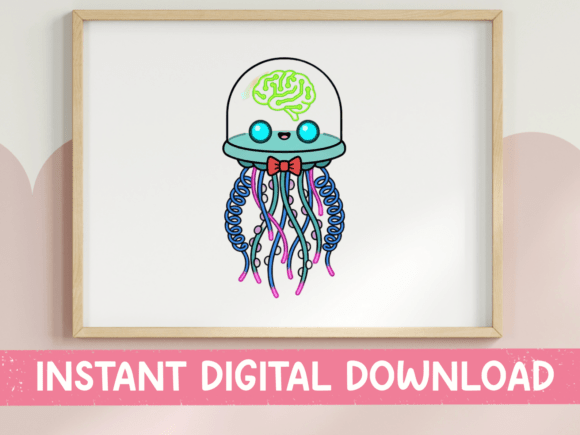
As a designer who spends more time staring at stitch simulations than actual fabric, I have developed a keen eye for what translates well from screen to needle. When I first pulled up the Brain Jellyfish UFO Alien Art file, my initial reaction was one of amused curiosity. It is not every day you encounter a motif that blends cerebral anatomy with retro sci-fi whimsy so seamlessly. The concept—a glowing green brain encased in a glass dome, perched atop a smiling teal saucer complete with a dapper red bow tie—is undeniably quirky. But charm alone does not make a viable embroidery product. We need to talk about how this design actually behaves under the needle.
First Impressions and Visual Personality
The mood of this piece is playful yet slightly surreal. It captures that specific niche of "weird and wonderful" that appeals to fans of offbeat humor and science fiction. Visually, the layout is compact but busy. The juxtaposition of the organic, tangled tentacles against the geometric smoothness of the glass dome and saucer creates an interesting tension. For an embroidery designer, this signals a need for careful thread management. The glowing green of the brain suggests high-contrast satin stitches or dense fill stitches to achieve that luminous effect, while the teal body likely requires a smoother finish to mimic the metallic sheen of a classic flying saucer.
This is not a minimalist line-art piece. It is a character-driven graphic with personality. In the world of T-Shirt Designs and Graphics, it stands out because it tells a story without words. It feels like a mascot for a boutique brand that doesn’t take itself too seriously. However, the complexity of the "long tangled" elements mentioned in the description raises immediate questions about stitch density and clarity on smaller scales.
Real-World Application: The Sweatshirt Test
To truly evaluate a machine embroidery design, I mentally place it on various substrates. Let’s consider a custom crewneck sweatshirt. This is arguably the ideal canvas for the Brain Jellyfish UFO Alien Art. The thick, textured fabric of a cotton blend sweatshirt provides the necessary stability for the denser areas of the design, particularly the brain and the saucer body.
In this scenario, the design would sit prominently on the left chest or as a larger centerpiece on the back. The red bow tie offers a crucial pop of color that breaks up the cool tones of the teal and green, drawing the eye to the "face" of the alien. Customers looking for unique custom apparel often seek items that spark conversation. This design does exactly that. It is memorable, which is key for Etsy sellers and small shop products trying to differentiate themselves in a saturated market. The whimsical nature makes it an excellent candidate for holiday gifts, particularly for science fiction enthusiasts or those who appreciate absurdist humor.
Versatility Across Product Lines
Beyond apparel, where else does this embroidery file shine? I see strong potential in home decor and accessories. Imagine this stitched onto a canvas tote bag design. The sturdy fabric handles the weight of the stitches well, and the quirky aesthetic aligns perfectly with the current trend of eclectic, personality-driven accessories. It could also work as an embroidered patch, provided the hoop size is sufficient to capture the detail of the tentacles without them merging into a solid blob of thread.
For baby embroidery, caution is advised. While the colors are bright and engaging, the intricate details might be too small for durable infant clothing that undergoes frequent washing. However, if scaled up appropriately and stitched on a sturdy item like a nursery pillow cover or a blanket border, it could serve as a unique thematic element for a space-themed room.
Technical Considerations and Stitching Challenges
Let’s get practical. The description mentions "long tangled" elements. In embroidery, long, thin, wandering lines are notoriously difficult to manage. They are prone to snagging and can look messy if the tension is not perfect. When working with this digital embroidery file, pay close attention to the stitch direction in the tentacle areas. If these are rendered as simple running stitches, they may lack definition. Ideally, they should be slightly thicker satin columns or carefully planned fill stitches to maintain visibility.
Stitch density is another critical factor. The glass dome effect relies on negative space and perhaps some subtle shading stitches. If the density is too high, the fabric may pucker, especially on thinner materials. Conversely, if it is too low, the "glowing" effect of the brain may be lost against the background. I strongly recommend testing the design on scrap fabric identical to your final product. Check how the green threads interact with the teal. Do they vibrate visually, or do they blend too much? Adjusting thread colors slightly—perhaps using a lighter lime green for highlights—can enhance depth.
Fabric and Hoop Constraints
This design is not suitable for every surface. Avoid using it on highly stretchy fabrics like jersey knits without a robust cut-away stabilizer. The weight of the brain and saucer could cause the fabric to distort over time. Similarly, curved surfaces like caps require careful digitizing to ensure the dome does not appear warped. If you are new to cap embroidery, start with a flat panel test.
Dark fabrics present a challenge for the teal and green elements. Ensure your thread choices have enough brightness to stand out against black or navy backgrounds. A white or light gray underlay might be necessary to prevent the fabric color from dulling the vibrancy of the alien features. Always review the design in a black-and-white mockup to check for contrast issues before committing to thread.
Commercial Viability and Branding
For craft business owners, the Brain Jellyfish UFO Alien Art offers a distinct advantage: niche appeal. It is not a generic flower or monogram. It targets a specific demographic that values uniqueness. This can drive higher engagement on social media and increase perceived value. When presenting this as a finished product, emphasize the handcrafted quality and the whimsical narrative. Use high-quality printable mockups that show the texture of the stitches to build customer trust.
However, professionalism is paramount. Ensure that the final stitching is clean, with no loose threads or jumped stitches. The "smiling" aspect of the saucer must be clear; if the mouth gets lost in poor tension, the character loses its charm. Consistency in presentation helps build brand recognition. If this becomes a signature piece for your shop, maintain strict quality control.
Final Designer Notes
Before launching this into your commercial embroidery lineup, verify the licensing terms. Not all design assets allow for unlimited commercial use. Confirm whether the file includes multiple formats compatible with your machine. Check the recommended hoop size; if it requires a large hoop, factor that into your pricing and production time.
In summary, the Brain Jellyfish UFO Alien Art is a bold, fun choice for designers willing to tackle its technical nuances. It excels in casual, conversational pieces like sweatshirts and totes. With proper stabilizer use, thread selection, and testing, it can become a standout item in your portfolio. It is a reminder that embroidery is not just about tradition; it is also about bringing weird, wonderful, and imaginative characters to life, one stitch at a time.